At-Home Microneedling vs a Professional Treatment: What Each Can Do
The short answer
At-home microneedling can leave skin feeling smoother and help a serum sink in, but it is not a smaller version of a clinic treatment. Home devices are built to stay near the surface: the American Academy of Dermatology points out that products sold for at-home use are not meant to puncture the skin, and that these gentler products give less noticeable results. The depths that soften acne scars and stretch marks, 1.0 to 2.5 mm, are set by a trained professional for a reason. A home device, used carefully, is fine for glow and texture; scars, deeper lines and stretch marks belong at a clinic. Most of the harm reported from home use comes from four avoidable things: a dirty head, too much pressure, using it too often, and what goes on the skin afterwards.
- Level Dthe lowest evidence grade, given to home microneedling devices in a 2026 review of home skin devices, which also linked them to infections.
- 17.6%smoother texture after three months of a 0.2 mm home device plus a growth-factor serum, in a small study of 11 women with no comparison group.
- 0.2 mm vs 2.5 mmthe needle length in that home study, against the deepest setting a clinic pen uses, for stretch marks on body skin.
What counts as at-home microneedling
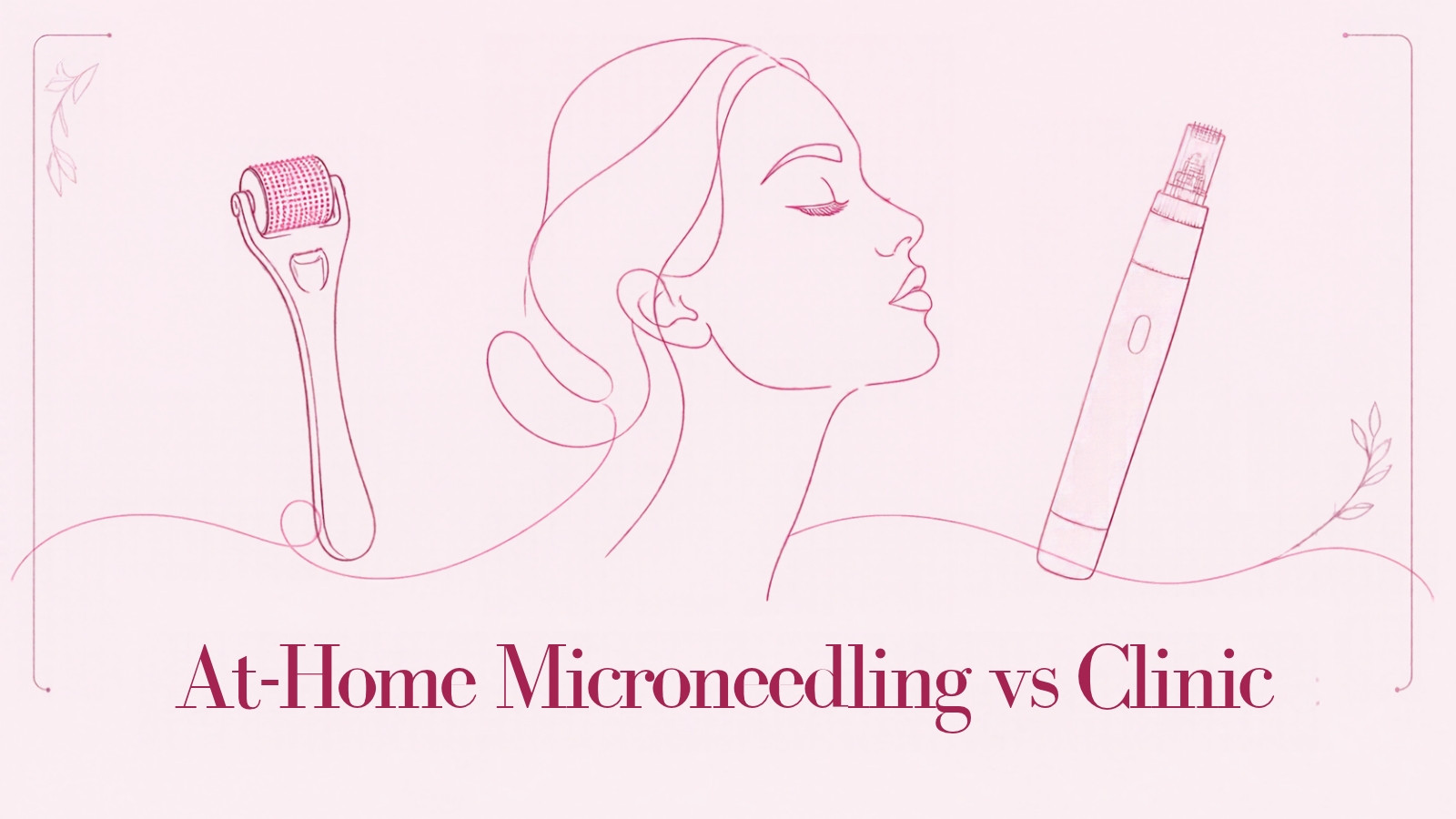
Three kinds of device are sold for use at home. A roller, often called a dermaroller, is a small drum covered in fine needles that you roll across the skin. A stamp presses a flat pad of needles straight down. A home pen is a battery-powered handpiece that drives a needle head in and out. They have three things in common: short needles at a fixed length, a head that gets reused from one session to the next, and one person working on their own face in a bathroom mirror.
With a roller or a stamp, your hand supplies the force, and the American Academy of Dermatology warns that pressing too hard can damage the skin, leaving scarring or a change in its colour or texture. Many home devices are sold as a way to help skincare absorb rather than as a scar treatment, which is closer to what a short needle can do.
A clinic treatment differs in three ways that matter more than the name of the device: depth, sterility and judgement. At Femme, every session uses a motorised pen with sterile single-use cartridges, the depth is adjusted area by area, and it is chosen only after an assessment of your skin on the Fitzpatrick scale and a look at your medical history. How that process changes the skin over the following weeks is explained on our microneedling page.
How deep each one goes
Needle depth in millimetres, on one scale. The grey bar is the home device used in a 2022 study; the pink bars are the ranges Femme works at, by concern.
- Home deviceTwice weekly, in a 2022 study0.2 mm
- Around the eyesCrepey texture and fine lines on the thinnest skin0.25 to 0.5 mm
- Acne scarsRolling and boxcar scars1.0 to 2.0 mm
- Stretch marksOn thicker body skin1.5 to 2.5 mm
Does at-home microneedling work?
For the surface, modestly. The most useful study of a home device we could find followed 11 women aged 33 to 61 with mild to moderate wrinkles. For three months they used a 0.2 mm home microneedling device twice a week, alongside a growth-factor serum applied twice a day. Skin imaging at the end showed texture 17.6% better and wrinkles 17.3% better, with fewer red areas and brown spots, and the women rated their own skin more highly. No serious side effects were reported.
Read it for what it is: a small study with no comparison group, in which the serum was used every day as well, so it cannot say how much of the change came from the needles. That is the wider picture too. A 2026 review that graded the evidence for every kind of home skin device put home microneedling at Level D, the lowest grade, and noted infections linked to it. Home fractional lasers reached Level A, and LED and radiofrequency devices Level B.
What a 0.2 mm needle cannot do is reach a scar. Rolling acne scars are held down by bands of tissue in the dermis, and clinic treatment for rolling and boxcar scars works at 1.0 to 2.0 mm, over six or more sessions spaced four to six weeks apart; our guide to how often to get microneedling sets out that schedule. Stretch marks sit on thicker body skin and are treated deeper still. Our guide to whether microneedling is worth it goes through what a clinic course does for each concern, including the trial evidence, and microneedling for acne scars covers the scar types it suits.
Is at-home microneedling safe?
Done properly, microneedling has a good safety record. A 2021 review of 51 studies covering 1,029 patients found that most side effects were the expected ones: redness, pain, swelling and temporary irritation. A second 2021 review, of 85 studies, found that most problems settled within about a week, but listed three that can last: dark patches after inflammation, tram-track scarring (lines of marks left by the needles), and granulomas, firm lumps caused by the immune system reacting to something in the skin. It named active infection, darker skin and metal allergies as the main risk factors, and advised caution with any product not made to go into the skin.
The risks particular to home use come from what is missing: a sterile, single-use head, a depth chosen for the area, and a second pair of eyes on your skin. The American Academy of Dermatology lists four.
- Overuse. Needling too often irritates the skin, which can make the very thing you were treating look worse.
- A device that pierces. If a home product does break the skin, the result can be an infection or scarring.
- Spreading a virus. Going over a wart, a cold sore or another viral infection can carry it across the face.
- Pressing too hard. Too much force can damage the skin and leave scarring or a change in colour or texture.
Published case reports show what that looks like. In one, a home roller spread chickenpox widely across a person’s face. In another, a 44-year-old woman developed an ulcer on her chin in which the tissue had died, after using vitamin E oil with an at-home device. A 2014 report described three women who developed facial granulomas after microneedling, two of them after the same branded vitamin C product had been needled into the skin, and a 2025 review gathered 15 such cases from 13 studies and noted they can be hard to treat. Motorised pens and topical vitamin C were implicated in most of those cases, so the lesson is about what goes onto freshly needled skin, wherever it is done. It is also why the skin is cleansed before a clinic session, so nothing is carried into the channels.
The advice people follow is often thin, too. A 2024 study of 61 popular TikTok videos on dermarolling rated the quality of their information as low to moderate. Videos by physicians scored higher and were more likely to mention the risks, but influencers reached the bigger audience.
If you are going to do it at home
- Keep it shallow and keep it yours. Use a device sold for home use, never share it, and clean it and replace the head exactly as the maker says.
- Only on calm, unbroken skin. Skip any area with active spots, a cold sore, warts, a rash or a cut.
- Light pressure, and less often than you think. More passes and more sessions do not mean more collagen; they mean irritation.
- Watch what goes on afterwards. Leave oils, vitamin C serums and anything fragranced off freshly needled skin. In the published cases, products like these were the trigger.
- Sunscreen every day. Irritated skin marks more easily, and darker skin is more prone to dark patches after inflammation.
- Know when to stop. Spreading redness, pus, blisters, a fever, or firm lumps that appear later need a doctor, not another session.
At home or at a clinic: side by side
| At home | At a clinic | |
|---|---|---|
| Needle depth | Short and fixed; 0.2 mm in the main home study | Set for each area: 0.25 to 0.5 mm around the eyes, 1.0 to 2.0 mm for acne scars, up to 2.5 mm for stretch marks |
| Best suited to | Glow, smoother-feeling skin, helping a serum absorb | Acne scars, fine lines, texture and stretch marks |
| Needles | A reused head that you clean yourself | A sterile cartridge, used once |
| Who decides | You | A technician, after a Fitzpatrick skin assessment and your medical history |
| Evidence | Small studies; graded Level D in a 2026 review | Randomised trials for acne scars |
| Cost | One device, used many times | $199 a session, or $499 for three, plus tax |
If you are weighing up other devices for home use, our honest look at at-home laser hair removal applies the same test of what a home version can and cannot reach.
Home or clinic? A quick check
Home or clinic check
Four questions. You get a straight answer on whether a home device fits what you want, and what to do instead if it does not.
1. What do you most want to change?
2. Is there anything on that skin right now?
3. Do spots, scratches or bites leave dark marks that linger for weeks?
4. Honestly, how would a home device be looked after?
A guide, not a diagnosis. Skin that is sore, spreading or slow to heal belongs with a doctor or pharmacist.
What a clinic course costs
Microneedling is offered at all twelve Femme clinics at the same price: $199 a session, or $499 for a package of three, and $225 a session, or $597 for three, with the neck included. Texture and fine lines usually respond in three to four sessions; acne scarring is planned as six or more. A home device costs less up front, but it is not doing the same job, so the fair comparison is against the result you want rather than the price of a session.
| Course | Before tax | Ontario, with 13% HST | Vancouver, with 5% GST |
|---|---|---|---|
| Face, one session | $199 | $224.87 | $208.95 |
| Face, three as a package | $499 | $563.87 | $523.95 |
| Face, six (two packages), for acne scarring | $998 | $1,127.74 | $1,047.90 |
| Face and neck, one session | $225 | $254.25 | $236.25 |
| Face and neck, three as a package | $597 | $674.61 | $626.85 |
Our microneedling cost guide sets these prices against other Canadian clinics, every treatment is on our pricing page, what a session feels like is in does microneedling hurt?, and the days afterwards are covered in our microneedling aftercare guide.
Questions about at-home microneedling
Does microneedling at home really work?
For the surface, modestly. In a small study, a 0.2 mm home device used twice a week with a growth-factor serum improved skin texture by 17.6% over three months, though there was no comparison group. Home devices are not made to reach acne scars or stretch marks, which need the deeper work of a clinic treatment.
Can I just do microneedling at home?
For glow and texture, yes, if you use a device sold for home use, keep it to yourself, keep it clean and only use it on calm, unbroken skin. For acne scars, deeper lines or stretch marks, a home device will not reach the depth that changes them.
What is the best at-home microneedling device?
No home device has strong evidence behind it: a 2026 review graded home microneedling at Level D, the lowest grade. Rather than a brand, look for short needles sold for home use, a replaceable head and clear cleaning instructions, and avoid any device that sells home use at scar depths.
Is it safe to do microneedling at home?
It can be, with care, but the risks are real. The American Academy of Dermatology warns that home use can irritate the skin, cause infection or scarring if the skin is pierced, spread warts and cold sores across the face, and scar or discolour the skin if you press too hard. Most problems trace back to a dirty head, overuse or the product applied afterwards.
Do dermatologists recommend at-home microneedling?
Not for treating scars. The American Academy of Dermatology says products sold for at-home use are not meant to puncture the skin and give less noticeable results, and it lists the risks of home use. A 2024 study of TikTok videos found that physicians posting about dermarolling were more likely than influencers to discuss those risks.
Does microneedling age you faster?
Faster ageing is not among the side effects listed in the published reviews of microneedling. What they do list is irritation from overuse and, less often, dark patches after inflammation, which are more likely on darker skin. Gentle pressure, sensible spacing and daily sunscreen keep both in check.
How often should you microneedle at home?
Follow the device instructions and do not go beyond them, because the American Academy of Dermatology warns that overuse irritates the skin. In the home study above, a 0.2 mm device was used twice a week. Clinic sessions go much deeper and are spaced four to six weeks apart, because collagen rebuilds over roughly four to twelve weeks.
Is a dermaroller the same as microneedling?
A dermaroller is one kind of microneedling device: a drum of fine needles rolled over the skin, usually at home. Clinic microneedling more often uses a motorised pen whose depth can be set for each area, with a sterile cartridge that is used once.
How much does professional microneedling cost?
At Femme it is $199 a session or $499 for three, and $225 a session or $597 for three with the neck, the same at all twelve clinics. Prices are before tax: 13% HST in Ontario or 5% GST in Vancouver.
Want the depth that reaches a scar? A consultation is built into your first appointment: your technician looks at your skin, asks about your history and tells you honestly how many sessions your concern needs before you commit to a course. Microneedling is available at all twelve clinics, and Femme treats women only.
Book an appointmentPrefer to talk first? Call 647-229-7397.
Sources
- American Academy of Dermatology. Microneedling can fade scars, uneven skin tone, and more.
- Raef HS, Gaumond SI, Geisler AN, Eber AE. Home-based dermatologic devices for acne and rejuvenation: evidence-based insights. Dermatologic Surgery, 2026.
- Quinlan DJ, Ghanem AM, Hassan H. Topical growth factors and home-based microneedling for facial skin rejuvenation. Journal of Cosmetic Dermatology, 2022;21(8):3469–3478.
- Gowda A, Healey B, Ezaldein H, Merati M. A systematic review examining the potential adverse effects of microneedling. Journal of Clinical and Aesthetic Dermatology, 2021;14(1):45–54.
- Chu S, Foulad DP, Atanaskova Mesinkovska N. Safety profile for microneedling: a systematic review. Dermatologic Surgery, 2021;47(9):1249–1254.
- Leatham H, Guan L, Chang ALS. Unintended widespread facial autoinoculation of varicella by home microneedling roller device. JAAD Case Reports, 2018;4(6):546–547.
- Huang C, Smoller BR, Kerstetter JC, Raza AS, Greas MR. Destructive facial granuloma following self-treatment with vitamin E oil and an at-home microneedling device. Cutis, 2025;116(4):146–148.
- Soltani-Arabshahi R, Wong JW, Duffy KL, Powell DL. Facial allergic granulomatous reaction and systemic hypersensitivity associated with microneedle therapy for skin rejuvenation. JAMA Dermatology, 2014;150(1):68–72.
- Friedmann DP, Mehta E, Verma KK, Harris R. Granulomatous reactions from microneedling: a systematic review of the literature. Dermatologic Surgery, 2025;51(3):263–266.
- Awad N, Hetzel J, Bhupalam V, Nestor MS. A cross-sectional content quality analysis of information in TikTok videos on “Dermarolling (Roller Microneedling)”. Journal of Cosmetic Dermatology, 2024;23(9):2996–2999.