Is Your Acne Hormonal? How to Tell, and What Actually Helps
Adult acne that arrives on a schedule, sits along the jaw and hurts before it shows is a different problem from teenage breakouts, and it does not respond to the same things. Here is how to tell what you are dealing with — and, just as usefully, what a skin clinic can and cannot do about it.
Four signals, and why no single one is enough
People usually try to identify hormonal acne from one clue: it is on my chin, so it must be hormonal. That is not reliable on its own. What is reliable is the combination — distribution, timing, texture and age of onset. When three or four line up, hormonal is a sound working assumption.
1. It sits low on the face
Jawline, chin, lower cheeks, often the sides of the neck. Not the forehead, not the nose.
Where hormonal acne sits
The oil glands in the lower third of the face carry more androgen receptors, so they respond first. The distribution is a map of where those receptors are.
- Typical of hormonal acneJawline, chin, lower cheeks, and often the sides of the neck. Deep, tender, slow to surface.
- Less typicalForehead and nose. Congestion here is more often the ordinary kind — blackheads and surface whiteheads.
Distribution is one signal of four. Timing, texture and age of onset matter just as much — the self-check below weighs all four.
2. It arrives on a schedule
In the second half of the cycle, oestrogen and progesterone fall away toward menstruation while androgen activity stays comparatively steady. It is the ratio shifting, not any single hormone spiking. Sebum production rises, pores congest, and because a spot takes days to travel to the surface, the flare typically lands seven to ten days before bleeding rather than on the day itself.
If you have never mapped it, do: note the dates for two or three months. A pattern that reliable is worth knowing, and it makes a consultation far more productive.
3. The spots are deep rather than surface
Hormonal lesions tend to be tender, firm, sitting under the skin, slow to come to a head and slow to leave. If what you have is mostly blackheads and small surface whiteheads, that is ordinary congestion — treatable, but a different problem.
4. It started, or got noticeably worse, in adulthood
Teenage acne that gradually improves is following its usual course, and what helps at each stage of it is set out in our guide to teenage acne. Acne that turns up at 27, or returns at 38 having been gone for a decade, is behaving hormonally.
A four-signal self-check
Not a diagnosis — a way of organising what you are already noticing, so a consultation starts further along.
Why the jawline, specifically?
Because that is where the receptors are.
Sebaceous glands are not uniform across the face. Those in the lower third carry a higher density of androgen receptors than those across the forehead, so when androgen activity rises — or when oestrogen drops and the balance tips — the glands along the jaw and chin respond first and hardest. They produce more oil, the follicle blocks, and the sequence that follows is the ordinary acne cascade: congestion, bacterial proliferation inside the blocked follicle, then rupture and inflammation. That cascade, and what acts on each stage of it, is set out in our main guide to getting rid of acne.
That last stage is the one that leaves a mark, which is why what you do during a flare matters as much as what you do between them.
The points in life it turns up
Hormonal acne clusters around the moments the balance changes, and this clinic sees all of them:
- PCOS. Jawline acne, irregular cycles and unwanted coarse hair together are a recognised pattern worth raising with a doctor. We have written separately about PCOS and hair removal, which is the same hormonal story showing up in hair rather than skin.
- Coming off hormonal birth control. Combined pills suppress androgen activity; stopping removes that suppression and the skin often rebounds for several months. It is one of the commonest reasons adult women get acne for the first time, and it usually settles.
- Pregnancy and postpartum. Both directions happen — some people clear, some flare, and postpartum is its own upheaval. Treatment options narrow considerably here, much as they do with laser hair removal during pregnancy.
- Perimenopause. Falling oestrogen against steadier androgens is the same ratio shift, sustained rather than monthly. It frequently arrives alongside facial hair at menopause, for exactly the same reason.
What a clinic can do, and what it cannot
This is where most acne content becomes vague, so plainly:
We cannot treat the hormonal driver. That is internal. Spironolactone, combined oral contraceptives and isotretinoin are prescription decisions and they belong with your doctor. Any clinic implying it can rebalance your hormones with a facial is overselling.
What we can treat is the skin. Three specific things, and they are worth doing:
- Keep the pore clear. The cascade starts with a blockage. Regular resurfacing means the follicle is less likely to congest in the first place — that is what bio microneedling and a chemical peel are doing, and why they are done as a course rather than once.
- Settle inflammation faster. Inflammation is what leaves the mark. Shortening it is the single most useful thing for preventing pigmentation, particularly on deeper skin.
- Treat what got left behind. See below — and note this is the part most people actually come in for.
Worth saying, because it surprises people: this does not have to wait until the acne has calmed down. The SQT bio microneedling complex is formulated for acne-prone skin specifically — a zinc ferment to help regulate oil, and antibacterial actives aimed at what proliferates inside a blocked follicle — so a course can run while breakouts are still active, not only once they have settled.
What that looks like
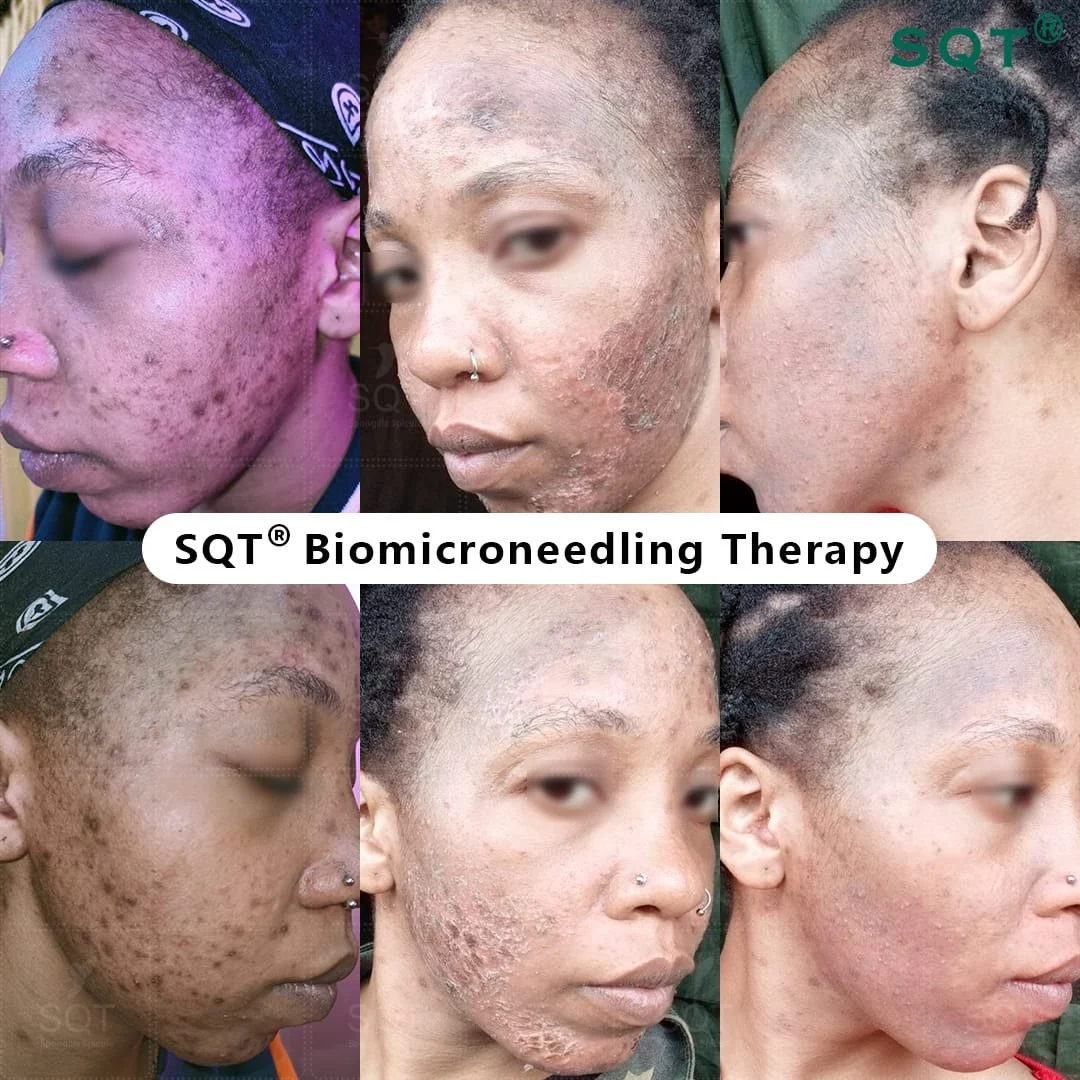

These are SQT’s own clinical images from clinics using the system, not photographs of Femme clients — we would rather say so than let you assume otherwise. Both show active inflammatory acne rather than settled scarring, which is the point: a course does not have to wait for the breakouts to stop. What any individual course achieves depends on your skin and how many sessions you run.
Marks are not scars, and it matters
Most people call everything acne leaves behind a scar. Usually it is not, and the distinction decides what will help.
A flat brown or purple patch is post-inflammatory pigmentation — the skin over-produced melanin while healing. It is a colour problem, it sits at the surface, and it fades, with time or considerably faster with treatment. It is also more common and more persistent on deeper skin tones.
A true scar is a texture change: an indent where tissue was lost, or a raised area where too much formed. Colour treatments do nothing for it, because the problem is the shape of the skin, not its shade. That needs something that remodels the tissue — which is what microneedling for acne scars is for. Different scar types need different treatments, and our guide to acne scar treatments helps you work out which you have.
Worth getting the diagnosis right before paying for the wrong treatment.
Two conversations, not one
If the self-check pointed toward hormonal, your doctor can look at what is driving it. Separately, a skin consultation deals with what is happening on the surface — keeping the pore clear, shortening each flare, and treating the marks.
Free consultation and patch test. If we think the answer is a doctor rather than a course of treatments, we will say so.
Questions we hear
How do I know if my acne is hormonal?
Four things together, rather than any one alone: it sits low on the face — jawline, chin, lower cheeks and sometimes the neck; it flares on a schedule, usually in the week or so before a period; the spots are deep and tender rather than surface whiteheads; and it started or got worse in adulthood. If three or four of those describe you, hormonal is a reasonable working assumption.
Why does hormonal acne appear on the jawline and chin?
The oil glands in the lower third of the face carry more androgen receptors than those on the forehead. When androgen activity rises — or when oestrogen falls and the ratio shifts — those glands respond first by producing more oil. The distribution is not a coincidence; it is a map of where the receptors are.
Why does it flare before my period?
In the second half of the cycle, oestrogen and progesterone both drop away toward menstruation while androgen activity stays relatively steady. That shifting ratio increases sebum production and pore congestion, and because a spot takes days to surface, the flare shows up roughly seven to ten days before bleeding rather than on the day.
Can a skin clinic fix hormonal acne?
Not the hormonal driver — that is internal, and prescription options like spironolactone, combined oral contraceptives or isotretinoin belong to a doctor. What a clinic can do is treat the skin: keep the pore clear so the blockage stage is less likely, calm the inflammation that follows, and treat the marks left behind. Those are worth doing, and they are not the same as treating the cause.
Is hormonal acne the same as PCOS acne?
PCOS is one cause of hormonal acne, not a synonym for it. Acne along the jawline, alongside irregular cycles and unwanted coarse hair on the face or body, is a combination worth raising with your doctor, because those three together are a recognised pattern. Plenty of hormonal acne has nothing to do with PCOS.
Will my acne get worse if I come off birth control?
Often, temporarily. Combined pills suppress androgen activity, so stopping removes that suppression and the skin can rebound for several months while it resettles. It is one of the most common reasons adult women develop acne for the first time, and it usually is not permanent.
Are the dark marks left behind actual scars?
Usually not, and the distinction changes what will help. Flat brown or purple marks are post-inflammatory pigmentation — the skin over-produced melanin while it healed — and those fade, with time or with treatment. A true scar is a change in the texture of the skin, an indent or a raised area, and that needs something that remodels the tissue.
Can I be treated while pregnant or breastfeeding?
It depends entirely on the treatment, and it is a conversation for consultation rather than a yes or no here. Several actives used for acne are contraindicated in pregnancy. Tell us at booking rather than on the day, so we can plan around it properly.
Does diet cause hormonal acne?
Diet is not the cause, though it can be an aggravator for some people. The honest position is that the evidence for any single food is weaker than the internet suggests, and blaming diet often delays people from addressing what is actually driving it. If you notice a consistent pattern with something specific, that is worth knowing — but it is not where to start.
Where to start
If the self-check pointed toward hormonal, two conversations are worth having rather than one. Your doctor can look at what is driving it — and if your cycles are irregular or you have noticed unwanted coarse hair alongside the acne, say so, because that combination is specifically worth investigating.
Separately, a skin consultation deals with what is happening on the surface: keeping the pore clear, shortening each flare, and treating the marks. We treat women only, across thirteen clinics in Ontario and British Columbia, and we will tell you honestly if we think the answer is a doctor rather than a course of treatments.