
How to Fade Dark Spots on Your Face: Clinic Treatments Compared
The short answer
Most dark spots on the face are one of two harmless things: sun spots, which build up after years of UV, or marks left behind where a pimple, scratch or irritation has healed. Both fade, but slowly. Once whatever caused a spot has stopped, a spot a few shades darker than your skin usually fades within 6 to 12 months, according to the American Academy of Dermatology, and treatment can shorten the wait. Daily broad-spectrum sunscreen is the step everything else depends on. Ingredients such as vitamin C, niacinamide, azelaic acid and retinoids help, and in clinic a series of chemical peels or bio microneedling speeds up the turnover of the marked surface layer. Two things change the plan: larger, mirrored patches may be melasma, which needs a diagnosis first, and any spot that changes in size, shape or colour needs a doctor rather than a fade cream.
- 6–12 monthsis how long a spot a few shades darker than your skin usually takes to fade once its cause has stopped, per the American Academy of Dermatology.
- 58%of 324 people being treated for acne in seven Asian countries had dark marks, and for more than half of them the marks had lasted a year or longer.
- 40–52%improvement in spots, blotchiness, texture and clarity after 32 adults wore SPF 30 every day for a year, in a small study with no comparison group.
What causes dark spots on your face
Skin gets its colour from melanin, a pigment made by cells called melanocytes. A dark spot is a patch where the skin has made more melanin than the skin around it, or where the pigment has clumped together. On the face, a handful of triggers account for most of them:
- Sun. UV speeds up melanin production, and years of it leave flat brown spots known as sun spots, age spots, liver spots or solar lentigines.
- Inflammation. A pimple, cut, burn, insect bite or a product that irritates your skin can leave a darker mark as it heals. The medical name is post-inflammatory hyperpigmentation, or PIH.
- Hormones. Pregnancy and hormonal birth control are linked to melasma, which shows up as larger patches rather than spots.
- Medicines. Some make the skin more sensitive to light or darken it as a side effect. Don’t stop a prescribed medicine on your own; ask the doctor who prescribed it whether it could be the cause.
- Less often, a medical cause, such as a thyroid disorder, an adrenal condition like Addison’s disease, or low vitamin B12 or folic acid. Spots that come with any other symptoms are worth showing to your doctor.
Sun spots are usually put down to age and sun alone, but a study of 523 middle-aged French women found more to it. Besides age, the severity of their sun spots was linked to their sun habits, a history of freckles, a darker natural skin colour and tanning easily, and to currently taking the pill or another progestogen treatment. The researchers said the hormone link needs more study, but it is one more reason to wear sunscreen daily if you use hormonal contraception.
Four kinds of dark spot, and where they tend to show
Each face shows the usual pattern for one kind. Many people have two at once, most often sun spots and marks left after breakouts.
- Sun spotsFlat, tan to dark brown, from freckle size to about 13 mm across, scattered where the sun reaches most: forehead, cheeks and nose.
- Marks after acneFlat brown, grey or dark marks exactly where a breakout, scratch or irritation healed. Not scars: only the colour has changed. They appear more easily on medium and deep skin.
- Possible melasmaLarger brown or blue-grey patches, often matching on both cheeks, the forehead, nose or upper lip, and often darker in summer. Needs a diagnosis before any treatment.
- A spot to get checkedOne spot that stands out from the rest: uneven in shape or colour, with a ragged edge, wider than 6 mm, or changing. That is a question for a doctor, not a fade cream.
Sun spots: protect first, then fade
Sun spots are harmless, and treating them is a cosmetic choice. They are more common after 50, but anyone who spends a lot of time in the sun or uses tanning beds can get them, and fair skin and a history of bad sunburns make them more likely. Because UV keeps making new ones, protection comes before anything else: a broad-spectrum sunscreen of SPF 30 or higher every day, reapplied every two hours when you are outdoors, a wide-brimmed hat, and shade between 10 a.m. and 2 p.m., when the sun is strongest. Spots that have been treated can come back if you skip this.
Sunscreen also helps the spots you already have. In a 2016 study, 32 adults applied a broad-spectrum SPF 30 to the whole face every day for a year. Every sign of sun damage the researchers graded had improved by week 12, and by week 52 blotchy and spotty pigmentation, texture and clarity had improved by 40 to 52%. The study was small, had no comparison group and was run largely by a skin care company’s researchers, but it agrees with the American Academy of Dermatology, which says effective treatment for dark spots begins with sunscreen.
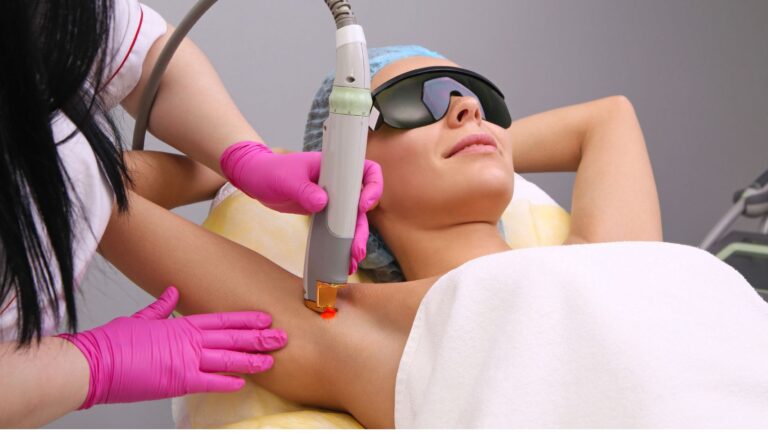
To fade the spots, the fade ingredients below work over weeks to months of steady use. Stronger prescription creams, such as hydroquinone or tretinoin, are a conversation for your doctor or pharmacist. Medical clinics also freeze sun spots or treat them with lasers; Femme doesn’t offer either for pigmentation, and our hair removal laser targets the pigment inside hair follicles, not spots on the skin. What we use is a chemical peel, which loosens the pigmented surface cells so they shed evenly. Sun-related pigmentation is one of the uses peels suit best, across a series of four to six visits three to four weeks apart, at eight of our Ontario clinics.
Marks left after acne: stop the cause, then speed up the fade
These marks are not scars. A scar changes the surface of the skin, while this kind of mark is flat, because only the colour has changed, and it fades with time. If you are not sure which you have, our acne scar guide shows how to tell them apart. The marks are very common with acne. In a 2016 survey of 324 people being treated for acne in seven Asian countries, 58% had them, and for more than half of those the marks had lasted a year or longer; 22% had had them for five years or more. A 2019 survey of 262 acne patients in the Middle East found them in 87%, with 53% saying their marks had been there for a year or longer. In both surveys, many patients found the marks as bothersome as the acne itself, or more so.
The most useful habit is to stop picking. In the Middle East survey, 69% of patients said they picked or scratched at their spots, and both research groups named it as a risk you can change. Next, treat the acne itself, because while breakouts keep coming, new marks keep replacing the ones that fade; our guides to getting rid of acne and hormonal acne cover that part. Retinoids help on both fronts, and a 2022 review of acne in skin of colour noted that breakouts usually settle weeks before the marks they leave, so judge progress over months, not weeks. If a skin care product seems to be causing marks, switch to one labelled fragrance-free or for sensitive skin.
Marks appear more easily on medium and deep skin tones, and they are slow to fade. The American Academy of Dermatology puts the usual fade time for a mark a few shades darker than your skin at 6 to 12 months once its cause is gone, while pigment sitting deeper in the skin, often slate blue to grey, can take years. On deeper skin, any treatment has to be gentle enough not to inflame the skin and start a new mark. Two small studies support peels done that way. In a 1999 pilot, 25 people with very dark skin (types V and VI), treated for concerns that included acne and dark marks, had a series of five salicylic acid peels two weeks apart; 88% improved moderately or significantly, and side effects were minimal to mild in 16%. In a 1997 trial in 19 patients with skin types IV to VI, adding six glycolic acid peels to a cream routine gave a trend toward faster and greater fading of their marks than the creams alone.
That is the approach we take. Every peel starts with an assessment on the Fitzpatrick scale, mandelic acid, which penetrates slowly and evenly, is often the better choice for deeper skin, and the strength builds across the series rather than in one visit. The other option is bio microneedling: fine silica spicules from a freshwater sponge, rather than needles, are massaged into the skin, and the treated surface turns over in about seven days. We use its revitalizing complex, which contains niacinamide and tranexamic acid, for pigmentation and dullness. Because no heat or light is involved, it is generally well suited to deeper skin, as long as the aftercare rules on sun and picking are followed.
Patches rather than spots: possible melasma
Melasma looks different from the spots above: larger patches, light to dark brown or blue-grey, often matching on both cheeks, the forehead, the nose or above the upper lip. It is far more common in women, who make up about 90% of people with it, it usually starts between 20 and 40, and it affects 15 to 50% of pregnant women, which is why it is called the mask of pregnancy. Light, including UV, visible light and heat, and hormones are its two main drivers, and it tends to darken in summer and ease in winter.
It needs a diagnosis before anything else, for two reasons. Several conditions look like it, sun spots and marks after acne among them, and the wrong treatment can make it worse; our hyperpigmentation treatment guide explains why an over-strong peel is a risk. Melasma is harmless and not a sign of cancer, but it tends to last for months or years and can return, and Cleveland Clinic notes there is no definitive treatment that will make it disappear. If your patches fit this pattern, start with your doctor or a dermatologist, and protect your skin from light every day in the meantime.
When a dark spot needs a doctor
Most dark spots are harmless, but skin cancer can look like one, and melanoma often starts as a mole or spot that changes. The Canadian Cancer Society’s ABCDE rule lists what to look for. See your doctor if a spot has any of these:
- A, asymmetry. One half does not match the other.
- B, border. The edge is ragged, notched or blurred, or the colour spreads into the skin around it.
- C, colour. The colour is uneven, with shades of tan, brown or black, and sometimes blue, grey, red, pink or white.
- D, diameter. It is wider than 6 mm, about the size of a pencil eraser.
- E, evolving. It changes in size, shape, colour or feel, or starts to itch, burn or tingle.
A spot that bleeds, oozes or won’t heal, or one that darkens or turns black, should be checked too. Don’t try to fade a spot like this, and don’t have it treated cosmetically until a doctor has looked at it.
What fades dark spots at home
Sunscreen first, because every fade ingredient loses to the sun. For medium and deep skin tones, the American Academy of Dermatology recommends a tinted sunscreen with iron oxide, which also protects against visible light, another trigger for dark spots. Then add one fade ingredient at a time, so you can tell what is working and what irritates:
- Vitamin C. An antioxidant that works alongside sunscreen and has a reputation for fading sun spots and other dark spots. In one study cited by Cleveland Clinic, 73% of people using it saw their pigmentation improve, although the effect faded once they stopped. Choose 10 to 20% L-ascorbic acid in a dark or tinted bottle, apply it in the morning under sunscreen, and give it about three months.
- Niacinamide (vitamin B3). It slows the handover of pigment from the cells that make it to the skin cells around them. In a 2002 study, 18 Japanese women with hyperpigmentation each used a 5% niacinamide moisturiser and a plain one, and the niacinamide significantly reduced their pigmentation within four weeks. It is also one of the actives in the revitalizing complex we use for bio microneedling.
- Azelaic acid, glycolic acid, kojic acid or a retinoid. These complete the American Academy of Dermatology’s list of over-the-counter ingredients that can fade existing spots. Retinoids, such as retinol or adapalene, can irritate at first; ask a pharmacist or your doctor which suits you, especially if you are pregnant or planning to be.
Just as important is what to leave out:
- Lemon or lime juice. Citrus contains furocoumarins, compounds that make skin react to sunlight. Juice on the skin followed by sun can redden within 24 to 48 hours and blister a day or two later, and the blisters typically heal into brown marks that take months to fade.
- Household bleach. Never put it on your skin.
- Unlabelled or imported fade creams. Some have been found to contain mercury or steroids that were not on the label. Mercury can damage the kidneys and nerves, and long-term steroid use can thin the skin or leave lasting discolouration.
- Scrubbing and picking. Working at a mark inflames the skin again, and inflammation is what causes these marks in the first place.
Which kind of dark spot is it?
Dark spot check
Five questions. You get the kind of spot your answers point to, what fades it, and a warning if anything you describe needs a doctor first.
1. Where are the dark spots?
2. How did they start?
3. What colour are they?
4. Has any spot changed in size, shape or colour, bled, or failed to heal?
5. Which best describes your skin tone?
A guide, not a diagnosis. Any spot that changes, bleeds or will not heal belongs with a doctor.
Every option side by side
There is no single best dark spot remover. The right choice depends on which kind of spot you have and on your skin tone, and daily sunscreen sits underneath all of them.
| Option | Best for | What to expect | Where |
|---|---|---|---|
| Broad-spectrum SPF 30 or higher, daily | Every kind | Stops new spots and darkening; pigmentation improved 40 to 52% over a year in one small study | At home |
| Tinted sunscreen with iron oxide | Every kind, especially on medium and deep skin | Adds protection from visible light, another trigger for dark spots | At home |
| Vitamin C serum | Sun spots, marks after acne | About three months to see results; the effect fades if you stop | At home |
| Niacinamide | Sun spots, marks after acne | Reduced pigmentation within four weeks in a small study | At home |
| Azelaic, glycolic or kojic acid, or a retinoid | Sun spots, marks after acne | Weeks to months of steady use | At home; some on prescription |
| Chemical peel series | Sun spots, marks after acne | Four to six visits, three to four weeks apart; strength matched to your skin | Eight Ontario Femme clinics, priced at consultation |
| Bio microneedling, revitalizing complex | Marks after acne, uneven tone, dullness | Surface turns over in about seven days; no heat or light | Eight Ontario Femme clinics, $250 |
| Microneedling | Indented acne scars and texture, rather than colour | Needs strict sunscreen while the skin recovers | All twelve Femme clinics, from $199 |
| Freezing or laser treatment | Sun spots | Medical procedures with their own risks | Medical clinics; not offered at Femme |
| Lemon juice, bleach, unlabelled creams | None | Can burn, blister or leave new marks | Best avoided |
If you have both dark marks and indented scars, our guide to chemical peel vs microneedling explains how the two treatments fit together. Darkening on the body, such as under the arms, usually has different causes, which our guide to dark underarms covers.
What dark spot treatment costs at Femme
Bio microneedling with the revitalizing complex is $250 a session, or $675 for three. Chemical peels are priced at consultation, because the acid and its strength are picked for your skin. Both are offered at eight Ontario clinics: Scarborough, Midtown Toronto, Concord / Vaughan, Whitby, Waterloo, St. Catharines, Stoney Creek and Cambridge. They are not offered at our London, Windsor, Ottawa or Vancouver clinics. If your marks come with indented acne scars, standard microneedling is $199 a session, or $499 for three, at all twelve clinics.
| Treatment | Before tax | Ontario, with 13% HST | Vancouver, with 5% GST |
|---|---|---|---|
| Bio microneedling, revitalizing complex, one session | $250 | $282.50 | Not offered |
| Bio microneedling, revitalizing complex, three sessions | $675 | $762.75 | Not offered |
| Chemical peel | At consultation | Eight Ontario clinics | Not offered |
| Microneedling, face, one session (for acne scars) | $199 | $224.87 | $208.95 |
| Microneedling, face, three sessions (for acne scars) | $499 | $563.87 | $523.95 |
Every treatment is listed on our pricing page.
Questions about dark spots on the face
What causes dark spots on the face?
Mostly sun and inflammation. UV speeds up melanin production and leaves sun spots over the years, and a pimple, cut, burn or irritating product can leave a darker mark as the skin heals. Hormones, including pregnancy and the pill, are linked to melasma, and some medicines, thyroid disorders and low vitamin B12 or folic acid can also darken the skin.
Why do I have dark patches on my face?
Larger patches, especially when they match on both cheeks, the forehead or the upper lip, are often melasma. It is driven by light and hormones, about 90% of people with it are women, and it is common in pregnancy and with hormonal birth control. It is harmless but long-lasting, and several conditions look like it, so ask your doctor or a dermatologist to diagnose it before you try to treat it.
How does vitamin C help dark spots?
Vitamin C is an antioxidant with a reputation for fading sun spots and other dark spots. In one study, 73% of people using it saw their pigmentation improve, although the effect faded once they stopped. Look for 10 to 20% L-ascorbic acid in a dark bottle, apply it in the morning under sunscreen, and allow about three months.
How long does it take for dark spots to fade?
Once the cause has stopped, a spot a few shades darker than your skin usually fades within 6 to 12 months. Pigment that sits deeper, often slate blue to grey, can take years. With acne, the breakouts usually settle weeks before the marks they leave. Daily sunscreen and treatment both shorten the wait, and skipping sunscreen lengthens it.
Can you get rid of dark spots naturally, or with lemon juice?
Not with lemon juice. Citrus juice makes skin react to sunlight, and juice plus sun can blister and leave brown marks that take months to fade. Never put household bleach on your skin either. The most effective natural step is sun protection: SPF 30 or higher every day, a wide-brimmed hat and shade in the middle of the day, which prevents new spots and helps existing ones fade.
Do chemical peels get rid of dark spots?
They can fade them. A peel loosens the pigmented surface cells so they shed evenly, and sun spots and marks left by acne respond across a series, usually four to six visits three to four weeks apart. Melasma is the exception. Peels are not done on a fresh tan or soon after a course of isotretinoin, and at Femme they are offered at eight Ontario clinics.
Does microneedling help hyperpigmentation?
Standard microneedling is used mostly for acne scars, texture and fine lines, and recovering skin pigments more easily, so daily sunscreen afterwards is essential. For dark spots and marks, Femme uses a chemical peel or bio microneedling, which works at the surface with a revitalizing complex for pigmentation and dullness.
When should I worry about a dark spot?
See your doctor if a spot is asymmetric, has a ragged or blurred edge, is uneven in colour, is wider than 6 mm, or is changing in size, shape, colour or feel. Bleeding, oozing or a sore that won’t heal are warning signs too. True sun spots are harmless, but skin cancer can look similar, so a doctor should check anything that fits.
How much does dark spot treatment cost?
At Femme, bio microneedling with the revitalizing complex is $250 a session or $675 for three, before tax; with 13% HST, that is $282.50 and $762.75. Chemical peels are priced at consultation. Both are offered at eight Ontario clinics, and neither at our London, Windsor, Ottawa or Vancouver clinics.
Not sure which kind you have? A consultation is built into your first appointment: your technician looks at your marks, assesses your skin type and tells you whether a peel or bio microneedling suits them, or whether a doctor should see them first. Both are offered at eight Ontario clinics, and Femme treats women only.
Book an appointmentPrefer to talk first? Call 647-229-7397.
Sources
- American Academy of Dermatology. How to fade dark spots in darker skin tones.
- Cleveland Clinic. Hyperpigmentation.
- Cleveland Clinic. Liver spots.
- Ezzedine K, Mauger E, Latreille J, et al. Freckles and solar lentigines have different risk factors in Caucasian women. Journal of the European Academy of Dermatology and Venereology, 2013;27(3):e345–e356.
- Randhawa M, Wang S, Leyden JJ, Cula GO, Pagnoni A, Southall MD. Daily use of a facial broad spectrum sunscreen over one-year significantly improves clinical evaluation of photoaging. Dermatologic Surgery, 2016;42(12):1354–1361.
- Abad-Casintahan F, Chow SK, Goh CL, et al. Frequency and characteristics of acne-related post-inflammatory hyperpigmentation. Journal of Dermatology, 2016;43(7):826–828.
- Abanmi A, Al-Enezi M, Al Hammadi A, Galadari I, Kibbi AG, Zimmo S. Survey of acne-related post-inflammatory hyperpigmentation in the Middle East. Journal of Dermatological Treatment, 2019;30(6):578–581.
- Callender VD, Baldwin H, Cook-Bolden FE, Alexis AF, Stein Gold L, Guenin E. Effects of topical retinoids on acne and post-inflammatory hyperpigmentation in patients with skin of color. American Journal of Clinical Dermatology, 2022;23(1):69–81.
- Grimes PE. The safety and efficacy of salicylic acid chemical peels in darker racial-ethnic groups. Dermatologic Surgery, 1999;25(1):18–22.
- Burns RL, Prevost-Blank PL, Lawry MA, Lawry TB, Faria DT, Fivenson DP. Glycolic acid peels for postinflammatory hyperpigmentation in black patients: a comparative study. Dermatologic Surgery, 1997;23(3):171–174.
- Cleveland Clinic. Melasma.
- Canadian Cancer Society. Signs and symptoms of melanoma skin cancer.
- Cleveland Clinic Health Essentials. What can vitamin C do for your skin?
- Hakozaki T, Minwalla L, Zhuang J, et al. The effect of niacinamide on reducing cutaneous pigmentation and suppression of melanosome transfer. British Journal of Dermatology, 2002;147(1):20–31.
- Cleveland Clinic Health Essentials. The science behind margarita burns.